

Once again, I turned to the Story Engine Deck for an idea. This prompt went far deeper than I anticipated, so the story took some time to write. Well, as you can see, it took on a life of its own.
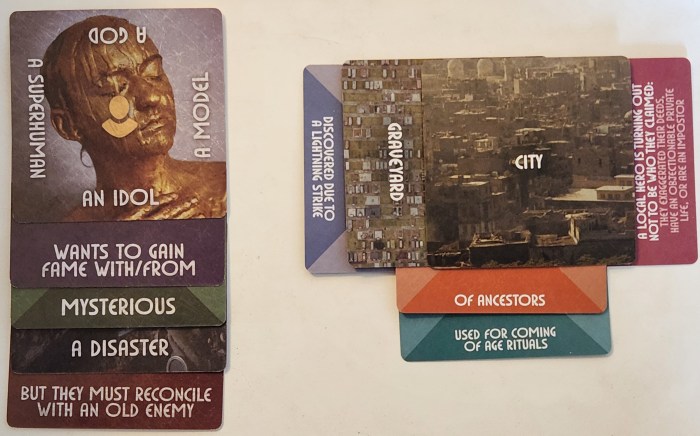
PROMPT: An idol (Lyryk?) wants to (gain fame from / write a heroic ballad about) a mysterious disaster (or legendary fighter/mage/bard?), (but they must reconcile with an old enemy?). In a city of ancestors used for coming-of-age rituals, a lightning strike exposes a local graveyard, uncovering a hidden/lost tomb. The discovery leads to a long-buried fact/journal/hidden history about the legend: they were nowhere near as heroic as their mythical deeds portray them. In fact, they were quite the opposite.
What happens when your “hero” turns out to be a cad and a coward who took credit for the actions of others? How can a bard with a conscience write a truthful ballad of heroism when the “hero” is not a hero at all?
~~
Years before, Lyryk Starsong learned that the dead never complained about how she described them. That, and the living paid good coin for a lie provided it had a catchy tune and a good chorus. She’d built her career on both principles, which had served her well enough. Sometimes, though, the dissonance ran contrary to her desires.
At ninety-nine summers, Lyryk was among the most celebrated bards in Adaran. Quite the accomplishment as a half-elf. She performed before lords, dukes, and, once, a drunken archimage who insisted on accompanying her on a bone flute. Her ballad ‘The Flame of the Goddess’ had earned her a silver harp, a jealous rival, and enough coin to give up the road if she ever stopped pursuing the various histories of the land.
More importantly, it’d made her famous.
Now, she stood in the Hall of Ancestors outside the city of Rithraunen, getting ready to face a thousand expectant faces, and preparing to become a legend.
The elves built the hall to honor the Elven ancestors who fought to defend the city during the Second Cataclysm. Its bone-pale towers rose around an ancient valley. Every family maintained a crypt, a shrine, or at least a niche in which to place the names of their ancestors. At ninety-nine, every elf underwent the Naming, a coming-of-age ritual in which they walked the old burial roads and spoke aloud the names of those whose lives had shaped their own. A ritual in which they laid their childhood name aside, and chose a name to guide their future.
The wealthy hired genealogists to trace their bloodlines to kings. The poor recited the names of grandparents, midwives, soldiers, and the occasional infamous thief. Rithraunen taught its children that no one truly died—so long as someone remembered them.
An impractical custom, came the gruff thought of her four-legged companion, Biscuit.
Maybe, but the remembrances keep the history alive. And mistakes from being repeated.
Biscuit had been her companion for more years than should have been possible. Not that she was complaining. She wasn’t one to question the gods, and the hound was most certainly a boon from a god, or a goddess—likely Ashta’Qi, her patron.
She’d come to the city at the behest of the magistrates for the Festival of First Names, when thousands gathered to honor the ancestors and hear songs of the greatest Elven champions. They’d commissioned her to write a new ballad celebrating Sir Pearis Ralivyn, the Starshield, the paladin who had, according to legends, saved Rithraunen from the Fallen Host following the Second Cataclysm.
His statue stood in every major square. A replica of his shining sword adorned the royal seal. Children learned his deeds before they learned their letters and numbers.
Lyryk had already written the first verse.
When darkness swallowed the hall’s white wall,
And blackness fell bleak as rain,
The Starshield stood before them all,
And broke the hosts in twain.
She admired the fine verse. Strong meter, satisfying rhyme, and just enough internal alliteration to make her feel clever when the crowd sang along. As she rehearsed the chorus, a storm spilled over the mountains without warning, dragging a stormy black and green sky behind it. Wind tore through the festival banners. The crowd scattered for shelter as thunder boomed overhead.
Lyryk remained on the stage, clutching the parchment, the storm’s dissonance making her head spin. She had a dramatic entrance planned. She hadn’t planned on the weather upstaging her.
Lightning struck the hill behind the Hall of Ancestors. The world flashed white, and a piercing, dissonant chord almost brought her to her knees. The ground bucked beneath Lyryk’s boots, and Biscuit appeared at her side, snarling. He pushed her toward shelter. Somewhere beyond the eastern colonnade, stone shattered with a great *CR-aaack*. The crowd screamed and surged toward the valley exit.
Lyryk dropped the parchment and grabbed the edge of the stage as it tilted, as Biscuit scrabbled for purchase on the wet wood.
When the thunder passed, she saw fingers of blue-white fire inching across the ground from the old graveyard. Not fire, she realized. Lightning still crawled beneath the earth in branching veins, lighting a deep crater amid the headstones. The strike split a buried tomb dug into the hill from top to bottom, exposing a staircase descending into the dark. Lyryk and Biscuit moved toward the breach, the music in her head drawing her to the boneyard.
That part of the graveyard had been sealed for centuries. Now, its oldest stones lay broken and scattered across the grass, and under it all rested a door of black iron bearing a symbol Lyryk knew better than her own handwriting.
A silver star pierced by a broken sword. Sir Paeris Ralivyn’s emblem. The crowd remaining fell silent.
Then, someone whispered, “The Starshield’s tomb.”
Lyryk’s heart raced. A hidden tomb. A legendary hero. And a portentous act on the eve of the festival. If the gods had wanted to write her next ballad themselves, they couldn’t have made a better argument. She searched for the parchment, but couldn’t find it. For the first time that day, she composed, writing nothing down.
Guards pushed their way forward to prevent anyone from entering the area. By sunset, the magistrates had surrounded the crater with guards, priests, and enough scholars to populate a small university.
Lyryk spent the rest of the night bribing and wooing her way past three separate barricades. She promised the magistrates a ballad, the priests a hymn, and the scholars an entire process poem devoted to the importance of proper archaeological procedures.
At last, a narrow-shouldered woman in a red scholar’s robe emerged from the tomb.
“Nobody enters,” she said, doggedly. “The structure is unstable, the wards are damaged, and the interior contains objects of considerable historical significance.”
“Does it contain Sir Pearis?” Lyryk asked.
The scholar looked at her, eyes narrowing, tone guarded. “His sarcophagus, yes.”
“His sword?”
“Possibly.”
“His armor?”
“Possibly.”
“His ghost?”
“Not that I have detected.”
“Shame. It would make the last verse much easier.”
The scholar did not smile. Her name was Zentha Sen, Keeper of the City’s Records, and she had the expression of a woman who’d spent her life correcting other people’s mistakes. Lyryk liked her right away, though she suspected the feeling wasn’t mutual. She’d have to work on that.
“I’d like to see the tomb,” Lyryk said, with a tone that held deference to the woman’s expertise.
“Why?”
“I’ve been commissioned to write the official ballad of the discovery.”
“That is not a reason to enter a dangerous tomb.”
“It’s a reason to enter a dangerous tomb before anyone else writes the ballad.”
Zentha studied her for a long moment. “You are Lyryk Starsong.”
“I am.”
“You wrote ‘The Flame of the Goddess’.”
“Yes.”
“You made Lord Thallan sound like a saint.”
“Lord Thallan paid me to make him sound like a saint.”
“Lord Thallan burned three villages to prevent a rebellion.”
Lyryk lifted her chin. “He paid me extra to omit the villages.”
“I see.”
Lyryk winced. Something in Zentha’s voice made her wish she’d embraced a different defense.
“Come, then.” The scholar turned toward the crater. “But touch nothing, and if the ceiling collapses, I shall consider it an instructive consequence.”
The tomb smelled of dry stone, dust, and old metal. Their lanterns revealed walls carved with scenes from Ralivyn’s life: the paladin kneeling before a radiant goddess, the paladin raising his sword against horrors; the paladin standing triumphant above fallen enemies. In each carving, his face remained serene.
Lyryk ran her fingers along the edge of her notebook, longing to touch the reliefs.
“Beautiful work,” she said.
“Propaganda is often beautiful,” Zentha replied.
Her tone caught Lyryk’s attention.
They descended into a chamber lined with bronze plaques. Every plaque bore a name, though many had been defaced. At the far end lay a stone sarcophagus beneath a fractured dome.
Ralivyn’s emblem shone on its lid. Lyryk stepped closer.
“‘Here lies Sir Pearis Ralivyn,’” she read. “‘Oath keeper. Defender. Beloved of the stars.’”
“Those titles were added long after his death,” Zentha said. Again, her voice held no emotion.
“How do you know?”
“Because the oldest inscriptions call him something else.”
She pointed to a line carved beneath the sarcophagus, hidden under a thick layer of dust. Lyryk crouched. The words cut into the stone were in a different hand.
Here lies Pearis Ralivyn, who bore the oath and broke it.
Lyryk stared at the inscription.
“That seems unnecessarily malicious.”
“Perhaps the dead had something to say.”
Before Lyryk could answer, Zentha crouched and lifted the lid of a small chest beside the sarcophagus. Inside lay an ancient leather journal, its cover blackened by age. The metal clasp had fused with the leather, but the scholar worked it loose using a thin knife.
The pages were brittle. Most had crumbled into flakes as she opened the cover, but the middle section remained intact. Zentha began reading. Then she stopped.
“What?” Lyryk asked.
The scholar’s face had gone pale.
“You need to see this.” Zentha handed her the journal.
The first surviving entry was dated two thousand one hundred years earlier, just days before the Battle of Rithraunen.
They gave Ralivyn command of the western gate. He says he’s the only one who can hold it. He says the goddess chose him. I seen him pray, and I seen him lie. I know which comes naturally to him.
The entry bore no signature. Lyryk turned the page.
The Fallen Host approaches. Forty soldiers, three clerics, and a company of farmers who never held a sword are all that’s left. Ralivyn took the best horses and rode south with his squires. Says he’ll fetch reinforcements. He’s been gone two days.
Lyryk felt the first cold thread of unease wind through her excitement.
“Who wrote this?”
“I don’t know,” Zentha said. “But the handwriting matches the inscriptions on the wall.”
Lyryk continued.
The gate fell. We retreat to the old aqueduct. Sister Delsanria ordered the wounded carried first. Captain Belinor stayed behind to hold the passage. I begged him to come with us. He laughed and told me to save my breath. We got no reinforcements. No Starshield.
The next entry, dated three days later.
We survived, but know not how. Delsanria called down a storm and shattered the Host’s siege engines. Belinor died at the aqueduct. Buried him under the western tower because we couldn’t carry him home.
Someone’s telling stories. They say Ralivyn returned at dawn with the king’s riders, that he slew the Fallen Captain in single combat. They say he stood alone at the gate and held back a thousand men. He returned yesterday, but didn’t bring riders. He took Delsanria’s account of the battle and told it like it was his own.
Lyryk read the lines again. The chamber tilted around her. She turned another page.
Delsanria confronted him before the council. He called her a liar and accused her of cowardice. He said a woman who survived the battle couldn’t have been responsible for its victory. And the council believed him! They named him the Starshield. They named Delsanria a traitor.
Lyryk lowered the journal.
“No,” she said. A foolish word, and she knew it as soon as it left her mouth.
Zentha said nothing.
“Anyone could have written this. Someone who hated him. Someone who wanted to discredit him.”
“Yes.”
“The journal could be forged.”
“Of course.”
“Then why do you look like you swallowed a stone?”
Zentha’s eyes moved to the broken sarcophagus.
“Because the names on these walls are not those of Ralivyn’s companions. They are the names of the people erased.”
Lyryk looked again at the chiseled plaques.
“Delsanria,” she whispered.
Zentha nodded.
“Sister Delsanria was a cleric of the Stars. The records say she abandoned her post during the battle. Her order struck her name from its rolls. Her descendants were barred from the Naming for seventeen generations.”
“And Belinor?”
“A captain who supposedly died fleeing the city.”
Lyryk glanced at the journal. “And Ralivyn?”
“The kingdom made him a saint.” The word echoed through the chamber.
Lyryk had sung his praises since childhood. She’d learned ‘The Starshield’s Lament’ at the Bardic College. Her first music tutor had insisted that Ralivyn’s courage represented the highest calling of a paladin: loyalty to the innocent, devotion to the divine, and the willingness to die for others.
Lyryk had believed every word. She’d built her reputation singing the deeds of men like him. Now, the pages trembled in her hands, and she couldn’t decide whether she wanted to cry or tear them apart.
“There’s more,” Zentha said quietly.
Lyryk turned the final surviving page.
Tonight, I found Ralivyn in the shrine. He stood before the altar demanding the goddess restore his power. He said he’d done what was necessary. He said Delsanria would have ruined everything by insisting on the truth.
The altar remained dark. He broke the sacred blade against its steps. When he left, the light followed him no farther than the door.
Beneath that entry, a final sentence written in a different hand, in different ink.
The gods did not abandon Pearis Ralivyn. He abandoned them.
Lyryk shut the journal.

