
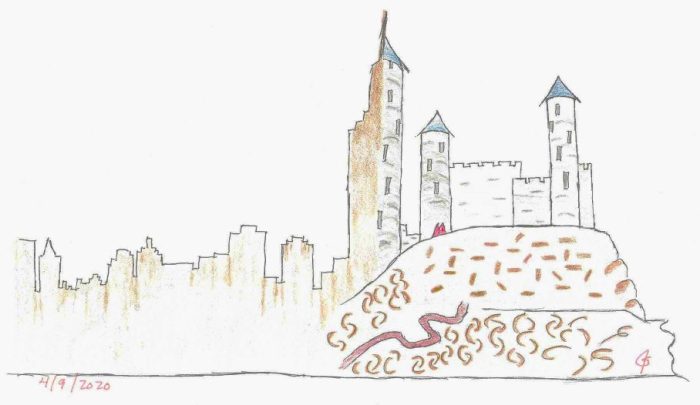
Once more, I’ve delved into my Story Engine cards for a prompt.
An impulsive wizard wants to create a portal, but must leave the familiar behind and face the unknown.
Ashten had always trusted motion more than thought. When doubt gathered like fog in his skull, he moved—hands busy, feet restless, magic already flaring before caution could catch its breath. It was how he’d learned spells faster than his peers. And how he’d burned down his first mentor’s herbarium. It was also why the circle etched into the stone floor of his tower glowed before he fully understood the cost.
The portal ring pulsed with a hungry blue light. Runes lifted from the stone like fish breaking water, then settled again, rearranged by his will. Ashten wiped his palms on his robe and grinned. It was working. It always worked when he let himself go.
A soft, offended chirr sounded from the window ledge.
Ashten turned.
“I know,” he soothed the kestrel perched there, all copper eyes and ash-gray feathers. “You don’t like the smell.”
Kyra flicked her tail and cocked her head. She’d been with him since the night he’d stolen a spell book from the Collegium and fled into the marsh. She’d found him shivering in the reeds at dawn, his hair slick with rain, and decided—without consulting him—that he was hers. Over the years she’d learned the taste of his moods, the sound of spells coiling in his chest. She was his familiar in the way gravity was faithful to falling things.
He crossed the room and offered his wrist. She stepped onto it, talons careful, and leaned into his throat. He breathed her in: smoke and iron and the faint sweetness of apples from the orchard below.
“I won’t be long,” he said, because lies were easier when they were small.
Kyra’s eyes narrowed. She made a sound like a warning.
Ashten laughed. “You worry too much.”
He’d chosen the portal destination on a whim, a point on no map, because the known places bored him. The Collegium taught that portals were doors between anchors, that safety lived in familiarity. Ashten believed safety was a story told to children so they wouldn’t wander into wonder. He wanted to see what lay between the stars of the atlas, in the blank spaces where the ink thinned and imagination reigned.
He returned to the circle and adjusted the runes. The air thickened. The tower groaned like an old animal. Kyra lifted from his wrist and landed on the table, feathers puffed, watching him with the disappointment of someone who knew how this would end.
When the portal opened, it did not tear the air so much as fold it. Blue light deepened into something darker, a well that drank the glow of the room. The smell changed—ozone and wet stone and something green and ancient. Ashten’s pulse leaped. This was it. The moment before a story began.
He stepped forward.
The portal shuddered.
Kyra screamed.
Ashten stumbled back, heart pounding against his ribs. The runes flared, then dimmed, then flared again, as if the circle were breathing. Tasting copper, his hands moved automatically. Correcting, coaxing, feeding power into the hungry mouth he’d opened. The portal resisted, not violently but firmly, like a door held shut by a palm on the other side.
“No,” he muttered. “Don’t do this now.”
Resistance grew. The air screamed. Ashten threw himself into the circle, boots skidding on stone, and grabbed for control. The portal surged, then narrowed, then snapped into a thin oval that hummed with strain.
Kyra launched herself from the table, wings beating hard, darting toward him.
The circle flared white.
A wrenching pull in his chest, as if a hook had caught him, yanked—hard. He cried out, clutching at his throat. The bond flared between them, a bright cord of sensation and instinct. He saw himself through Kyra’s eyes for a heartbeat—the tower, the portal, his own face wild with hunger—then the cord stretched, thinned, and sang.
“No,” he wailed, and this time it was not to the portal.
The bond snapped.
Silence crashed in.
Ashten fell forward into the portal as it closed like a held breath released.
He landed hard on damp ground. Pain flared up his arms. Rolling, he came to his knees, gasping. The air tasted wrong—thick and sweet, like sap. He looked up.
The sky was a bowl of green glass, light filtering through leaves the size of sails. Trees rose around him, their trunks braided and knotted, bark pale as bone. Vines hung like curtains, twitching when the air moved. Somewhere, water gurgled.
Ashten laughed, breathless and shaking. He did it. He was here. The unknown opened around him like a promise.
Then the emptiness hit.
He reached for Kyra without thinking, a reflex as old as breath. He found nothing. No answering warmth, no edge of shared sight. The place in his chest where she lived felt scooped clean.
Ashten pressed a fist to his sternum.
“Kyra,” he said, and the name fell flat.
The forest listened. Leaves rustled. Something skittered away.
He stood slowly, dizzy. The portal was gone. The air where the portal had been carried no memory of it. He swore softly, then louder, pacing in a tight circle, hands tugging at his hair. He knew this could happen. The Collegium had lectured about strain and bonds and the danger of long-distance travel. And he’d nodded, bored, already planning the next spell.
Impulses had costs. He’d always paid them gladly. But this one lodged like a stone in his throat.
Ashten forced himself to breathe. Panic was a poor teacher. He took stock. His satchel had made it with him—good. He had chalk, a knife, a few crystals, and a loaf of bread that now smelled faintly of moss. His staff lay nearby, wood humming, pleased to be somewhere new.
He swallowed and set off.
The forest resisted him in small ways. Roots rose underfoot. Vines snagged his sleeves. When he cut a path, sap bled, and the wound closed behind him. The light shifted, green to gold to something like burnished copper, without the sun ever showing itself. Time felt stretchy, unreliable.
He walked until his legs shook and his thoughts went in circles that all ended at the same empty place. Trying to sketch a return circle, he found the ground refused the chalk, lines blurring as if rubbed by invisible fingers. He cursed and laughed and nearly cried.
As night—or something like it—settled, the forest changed its tune. Insects chimed. Leaves whispered secrets he could not quite hear. Ashten made a small fire with magic that smelled like rain and sat with his knees pulled up, staring into it. He imagined Kyra on the tower ledge, feathers ruffled, eyes sharp. Imagined her waiting. Imagined her hurt.
“I didn’t mean to,” he told the fire, because the forest felt like an audience. “I thought… I thought I could bring you next time. I thought—”
The fire popped. A shadow moved at the edge of the light.
Ashten’s hand went to his knife. “Hello?”
The shadow resolved into a figure no taller than his chest, bark-skinned and bright-eyed, with leaves for hair. It regarded him with interest, head tilted. When it spoke, its voice sounded like wind through hollow reeds.
“You broke a door,” it said. “The forest felt it.”
Ashten swallowed. “I’m sorry.”
The creature blinked.
“Are you?”
He considered. Honesty, he had learned, was another kind of magic.
“Yes,” he said. “And no. I wanted to see what was here.”
The creature smiled, a crack in bark.
“You are a wanting thing.”
“I am,” Ashten agreed. “Can you help me go back?”
The creature studied him for a long moment. The fire reflected in its eyes like stars.
“Doors ask for payment,” it said finally. “You paid already.”
Ashten’s chest tightened. “I didn’t mean to.”
“Meaning is a human comfort,” the creature said, not unkindly. “The forest does not use it.”
Ashten stared into the fire. He thought of Kyra’s weight on his wrist, the way she knew him better than he knew himself. He’d always run toward the next bright thing, but had never practiced staying.
“What do I do now?” he asked.
The creature shrugged, leaves rustling.
“Learn where you are. Learn what you have lost. Build a new door, perhaps. Or do not. The unknown is patient.”
Ashten laughed weakly.
“That doesn’t sound like me.”
The creature’s smile widened.
“People change.”
When the creature left, the forest seemed quieter, as if waiting. Ashten lay back on the damp ground and stared up at the green sky. He reached again, habit tugging him toward the bond that was no longer there, and stopped himself. The ache did not vanish, but it softened, becoming something he could carry.
He slept and dreamed of wings.
In the days—or weeks, or months—that followed, Ashten learned. He learned the rhythm of the forest, the way paths appeared if he walked without forcing them. He learned the language of vines and the taste of sap that healed cuts. He learned to sit with his hands still, to listen before acting. The forest taught him because it had time.
He built a shelter from fallen leaves and woven light, and practiced magic that coaxed rather than commanded. Sketched circles that did not blur when he accepted their refusal. Understood doors were not just openings but agreements.
One evening, as he traced a careful rune in the air, he felt a tug—not the bond he missed, but something like an echo. He closed his eyes and breathed. He did not reach; he waited.
In the waiting, he felt it: a thread, thin but real, stretching toward somewhere familiar. He smiled, slow and sure.
“I’m coming,” he whispered, not with the reckless promise of before, but with the steadier weight of intention.
The unknown did not rush him. It watched, curious and kind.
 J.J. Shaun